A power of attorney is the document that lets someone in Saudi Arabia act for you: file a trademark, sign before a government body, appear in court, or collect a debt. The route you take depends on two questions. Where are you when you sign it? And are you signing for yourself, or for a company? This page walks through each route in order.
1. Which route applies to you?
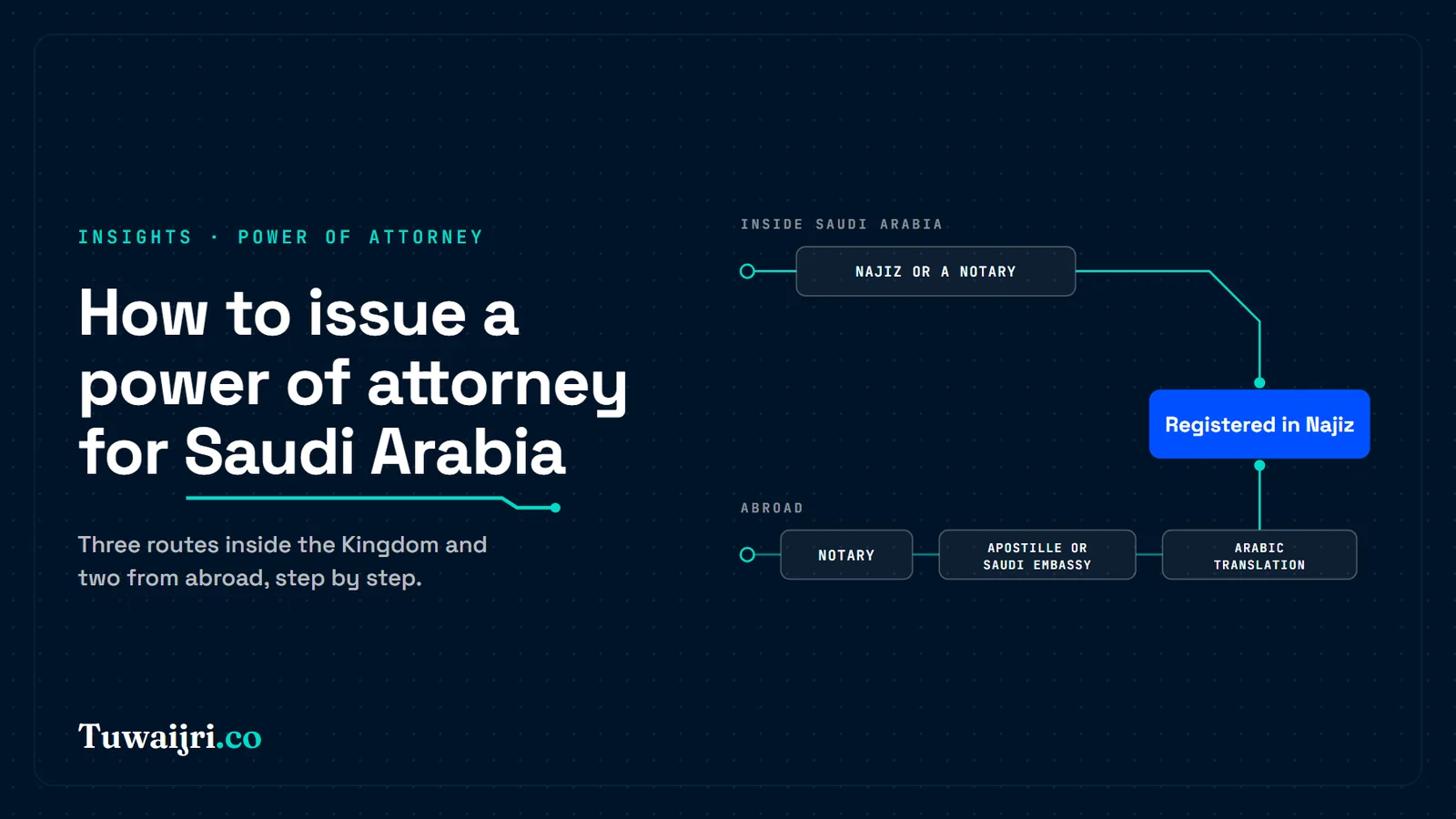
Start with where you will be when you sign. Inside the Kingdom there are three routes: Najiz, a public notary, or a private notary. Abroad there is one route with two variants, and the variant depends on whether your country is a member of the Apostille Convention.
| Where you sign | Signing for | Route |
|---|---|---|
| Inside Saudi Arabia | Yourself | Najiz (fastest), a public notary, or a private notary |
| Inside Saudi Arabia | A company or other entity | Najiz Business, a public notary, or a private notary |
| Abroad, Apostille member country | Yourself or a company | Local notary, then Apostille, then an official Arabic translation and the Ministry of Justice in Saudi Arabia |
| Abroad, not an Apostille member | Yourself or a company | Local notary, then the Saudi embassy, then an official Arabic translation, the Ministry of Foreign Affairs, and the Ministry of Justice in Saudi Arabia |
2. How do you issue a power of attorney inside Saudi Arabia?
Inside the Kingdom you have three options: Najiz, a public notary, or a private notary. Najiz is the quickest, and it has two doors: Najiz for a power of attorney in your own name, and Najiz Business for one given on behalf of a company. A notary is the route when you want someone to handle the Arabic forms for you.
Option 1: Najiz, or Najiz Business for a company
Najiz is the Ministry of Justice's online services portal. You log in with Nafath (the national digital identity app), fill in the power of attorney form, and submit it. Every field is in Arabic, so most non-Arabic speakers need someone beside them to complete it.
Use the right door for the capacity you sign in. A power of attorney you give in your personal capacity, on your own behalf, goes through Najiz. A power of attorney given in a representative capacity, on behalf of a company, goes through Najiz Business, the Ministry's electronic power of attorney service for businesses.
- Log in to Najiz (or Najiz Business, for a company) through Nafath.
- Open the power of attorney service and fill in the details of the principal (you, or the company), the agent, and the powers you are granting.
- Submit the application and confirm it.
- The power of attorney is issued electronically and appears in Najiz.
Option 2: a public notary, booked through Najiz
A public notary is a notary employed by the Ministry of Justice. This route has two stages. First, a power of attorney application is filled in on the Ministry's old portal, which produces an application number. Second, you submit that number through your own Najiz account, and the public notary schedules an appointment to confirm the application with you and issue the power of attorney.
The second stage must come from your own Najiz account. Your agent cannot submit it for you. Your agent can do the first stage: fill in the form, receive the application number, and pass it to you, so your part is reduced to submitting the number and attending the appointment.
- You or your agent fill in the power of attorney application on the Ministry of Justice's old portal.
- The application number is issued.
- You log in to Najiz with your own account and submit the application number.
- The public notary schedules an appointment.
- You attend, confirm the application, and the notary issues the power of attorney.
Option 3: a private notary
A private notary is a notary licensed by the Ministry of Justice who works outside the Ministry, usually a lawyer. Private notaries are easy to find, they know what the document needs, and many will come to your office to issue it. This is often the simplest route for a busy executive or for a company that wants the drafting and the issuance handled in one visit.
- Contact a private notary and explain what the power of attorney needs to cover.
- The notary prepares the power of attorney.
- You meet the notary (at their office or yours), confirm the power of attorney, and it is issued.
How the three routes compare
| Najiz | Public notary | Private notary | |
|---|---|---|---|
| Who issues it | The Ministry of Justice, electronically | A Ministry of Justice notary | A notary licensed by the Ministry of Justice |
| Personal capacity (for yourself) | Yes | Yes | Yes |
| Representative capacity (for a company) | Yes, through Najiz Business | Yes | Yes |
| Do you need a Najiz account? | Yes | Yes, to submit the application number | No |
| Language of the forms | Arabic | Arabic | The notary handles it |
| Meeting in person | No | Yes, at the scheduled appointment | Yes, often at your office |
3. How do you issue a power of attorney from outside Saudi Arabia?
If you are abroad, you sign the power of attorney before a notary in your own country and authenticate it so Saudi authorities will accept it. How you authenticate it depends on whether your country is a member of the Apostille Convention (the Hague Convention of 5 October 1961 on the authentication of public documents). Saudi Arabia is a member, so for documents from other member countries the Apostille replaces the longer embassy chain.
In both variants the original paper document has to reach your agent in Saudi Arabia by post. Before it goes to any Saudi authority, it must be translated into Arabic by an official translator authorised in Saudi Arabia, which is why the translation is usually arranged once the original arrives in the Kingdom. The process ends the same way: your agent takes the original and its translation to the Ministry of Justice, which records it officially so it appears in Najiz.
If your country is an Apostille member
An Apostille is a single certificate, issued by a designated authority in your own country, that confirms the notarisation is genuine. With it, your power of attorney needs no embassy stamp.
- Sign the power of attorney before a notary in your country.
- Obtain the Apostille from your country's designated authority.
- Post the original power of attorney to your agent in Saudi Arabia.
- Arrange the Arabic translation by an official translator authorised in Saudi Arabia (usually through your agent).
- Your agent takes the original and the translation to the Ministry of Justice, which notarises it officially.
- The power of attorney is registered and appears in Najiz.
If your country is not an Apostille member
Without the Apostille, the document goes through legalisation: a stamp from the Saudi embassy in your country, then a stamp from the Ministry of Foreign Affairs in Saudi Arabia, then registration with the Ministry of Justice. It takes longer, mainly because of the extra appointment in Saudi Arabia.
- Sign the power of attorney before a notary in your country.
- Have the original stamped (legalised) by the Saudi embassy in your country.
- Post the original power of attorney to your agent in Saudi Arabia.
- Arrange the Arabic translation by an official translator authorised in Saudi Arabia (usually through your agent).
- Your agent books an appointment with the Ministry of Foreign Affairs in Saudi Arabia and fills in its online form.
- At the appointment, the Ministry of Foreign Affairs stamps the power of attorney.
- Your agent takes the original and the translation to the Ministry of Justice, which notarises it and registers it in Najiz.
4. What slows a power of attorney down?
In our experience, delay rarely comes from the government step itself. It comes from the steps around it.
Signing in the wrong capacity. A director who signs through Najiz in their own name has given a personal power of attorney, not one for the company. If the agent is meant to act for the company, use Najiz Business or a notary.
Sending a copy instead of the original. For a power of attorney signed abroad, the Ministry of Justice works from the original paper document. A scan does not replace it.
Forgetting the translation. A power of attorney signed abroad in another language needs an Arabic translation by an official translator authorised in Saudi Arabia before any Saudi authority will accept it. Build that step into your timeline.
Skipping the Apostille check. Confirm your country's Apostille status before you sign. It decides whether you need an embassy appointment at all.
Powers drafted too narrowly. A power of attorney that covers "registering a trademark" may not cover renewing it, opposing a conflicting mark, or going to court. Agree the list of powers with your agent before you sign, because changing it later means repeating the whole route.
Frequently asked questions
Can I issue a power of attorney for my company through Najiz?
Yes, through Najiz Business, the Ministry of Justice's electronic power of attorney service for companies. The personal Najiz service covers only a power of attorney in your own name. A public notary or a private notary can also issue one for a company.
Can my agent submit the Najiz request for me?
Your agent can fill in the application and receive the application number, but the submission through Najiz must come from your own account.
Is Saudi Arabia a member of the Apostille Convention?
Yes. A power of attorney from another member country needs an Apostille instead of Saudi embassy legalisation.
Do I need to post the original power of attorney?
Yes, for a power of attorney signed abroad. Your agent needs the original to register it with the Ministry of Justice.
Does a power of attorney signed abroad need to be translated?
Yes. It must be translated into Arabic by an official translator authorised in Saudi Arabia before it goes to any Saudi authority.
How do I know the power of attorney is registered?
Once the Ministry of Justice has recorded it, the power of attorney appears in Najiz and can be checked there.
Tuwaijri (2026), How do you issue a power of attorney for use in Saudi Arabia?, tuwaijri.co. https://tuwaijri.co/insights/saudi-power-of-attorney